

A Sweet New Year in Fes:
Discovering Jewish-Moroccan Heritage Through Food
Fes is a city of layers.
Behind its ancient walls are centuries of stories, traditions and encounters between different cultures and communities. Its heritage can be discovered through architecture, craftsmanship, music and, perhaps most deliciously, through food.
As Rosh Hashanah approaches, the Jewish New Year offers a particularly meaningful way to discover one of the many cultural traditions that have contributed to the history of Morocco.
For Moroccan Jewish families, Rosh Hashanah is not only a moment of prayer and reflection. It is also a celebration around the table, where symbolic ingredients express hopes for sweetness, prosperity and a good year ahead.
In Fes, this tradition connects beautifully with the city’s extraordinary culinary heritage.
Rosh Hashanah and the Meaning of a Sweet Year
Rosh Hashanah marks the beginning of the Jewish New Year and traditionally begins a period of reflection and renewal.
Food plays an important role in the celebration. Across Sephardic and Mizrahi communities, including Moroccan Jewish communities, families may serve symbolic foods known as simanim, or signs. The exact foods and customs vary between families, but their purpose is to express hopes and blessings for the coming year.
Among the best-known examples are sweet foods such as apples and honey, representing the wish for a good and sweet year.
Moroccan Jewish traditions add their own rich culinary character to this idea.
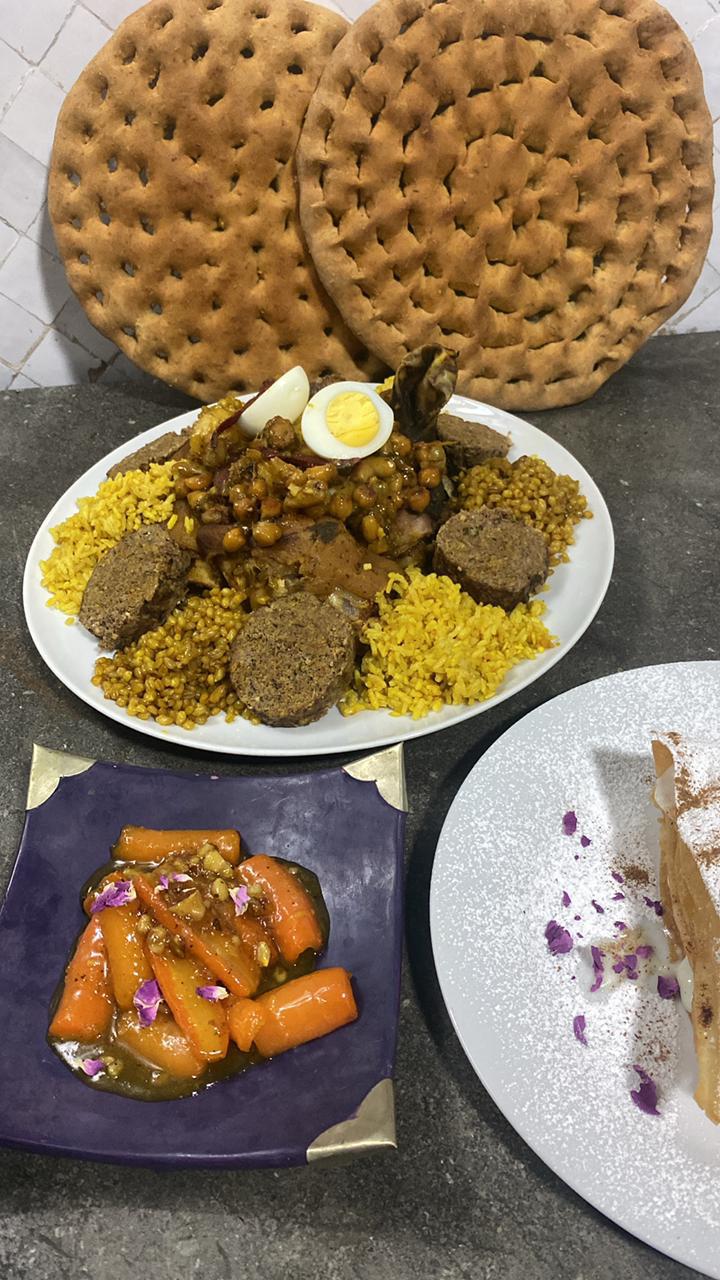
Dates, pomegranates, vegetables, dried fruits, nuts and aromatic spices can all find a place on the festive table.
The result is a celebration in which every ingredient can tell a story.
The Flavours of Moroccan Jewish Heritage
Moroccan Jewish cuisine developed within the broader culinary landscape of Morocco.
For generations, Jewish communities across the country cooked with the ingredients available around them, while observing Jewish dietary traditions and creating recipes particular to their families and communities.
This resulted in a cuisine that feels unmistakably Moroccan while also carrying its own identity.
Think of fragrant spices, slowly cooked vegetables, couscous, fish, poultry, dried fruits, almonds and sweet-and-savoury combinations.
In many Moroccan Jewish families, recipes became treasured family memories, passed from one generation to another.
Food became a way of preserving identity.
A Table That Brings Stories Together
Perhaps the most beautiful connection between Rosh Hashanah and Fes is the idea of gathering.
A festive table brings people together.
A recipe connects generations.
An ingredient can carry a blessing.
And a meal can preserve a story.
This is particularly meaningful in Fes, a city where Jewish and Muslim communities have contributed to a shared Moroccan cultural landscape over generations.
The historic Mellah remains an important part of Fes’s heritage, reminding visitors that the city’s history has always been shaped by different communities and traditions.
Experiencing Fes Through Palais Amani : a Different Way to Discover Fes:
A journey through Fes does not have to begin with a monument.
It can begin with a date, a pomegranate, a handful of almonds, the scent of cinnamon or the sound of a market coming alive in the morning.
Rosh Hashanah reminds us that food can express something much larger than taste: hope for the future, gratitude for the past and connection between generations.
In Fes, those ideas feel especially at home, because here, heritage is not locked away in a museum.
It lives in the medina.
It lives in the markets.
It lives in the kitchens.
And it lives around the table.
At Palais Amani, we invite our guests to experience Fes not only as a destination, but as a story — one that can be discovered through its architecture, its people, its traditions and its extraordinary cuisine.
Mariem Trifi